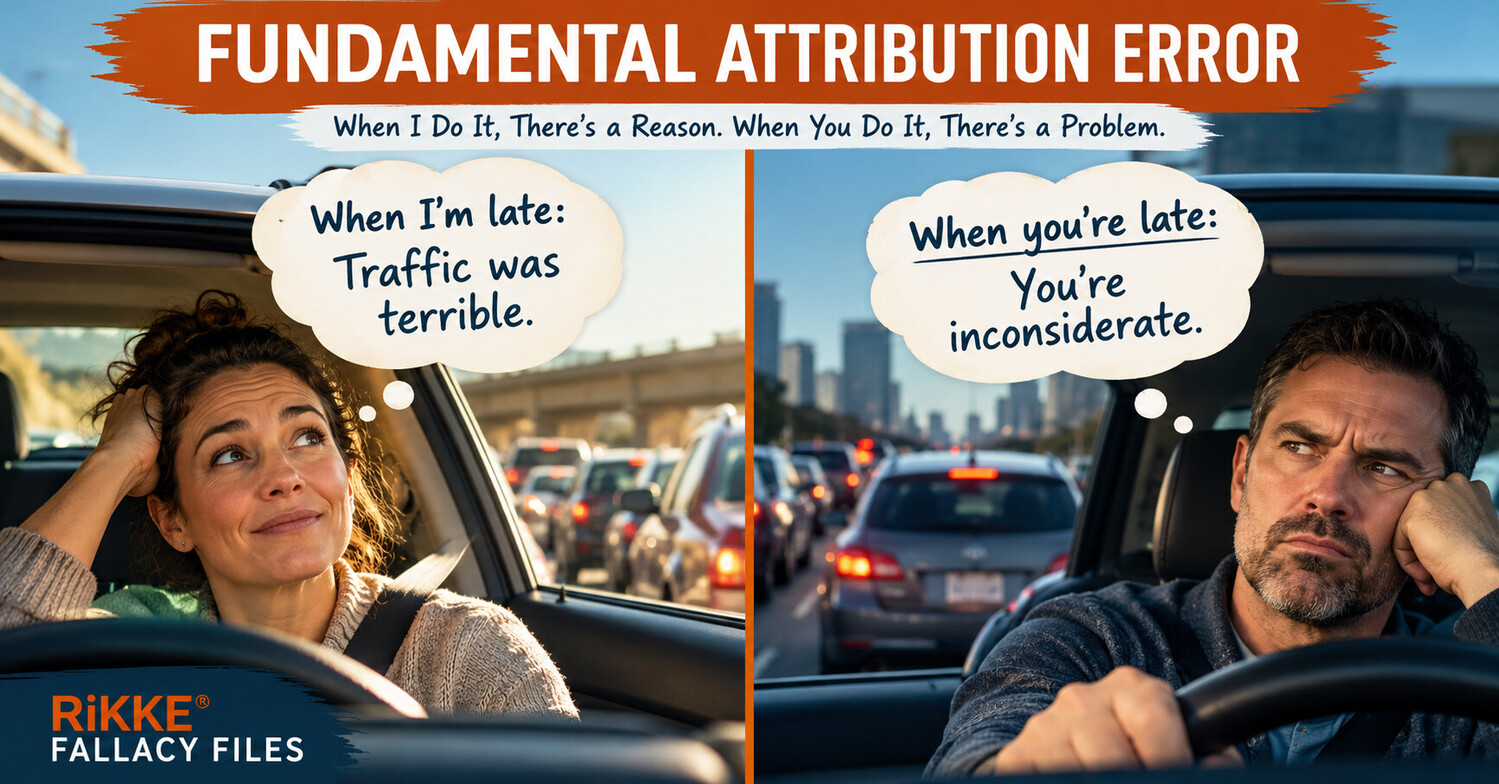
You're late because traffic was terrible.
Someone else is late because they're inconsiderate.
You skip a workout because you've had an exhausting week.
Someone else skips a workout because they're lazy.
You snap at someone because you're stressed.
They snap at you because they're a jerk.
Sound familiar?
Welcome to the Fundamental Attribution Error, one of the more entertaining (and humbling) ways our brains get things wrong.
The Trap
The Fundamental Attribution Error is our tendency to explain other people's behavior by their personality while underestimating the circumstances influencing their actions.
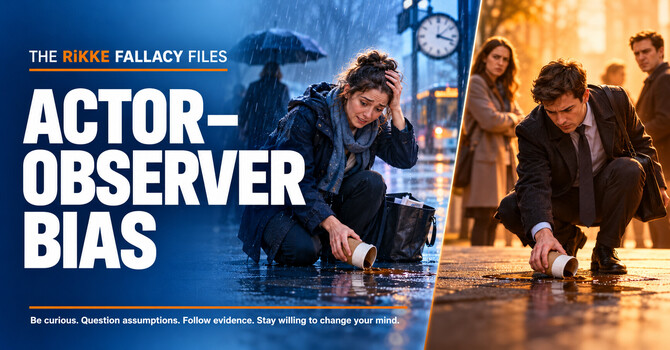
A closely related concept, actor-observer bias, describes how we may give ourselves the benefit of the doubt because we know our circumstances, but judge others based on what we see.
We know the backstory behind our own behavior. We rarely know theirs.
The result? We can become remarkably generous defense attorneys for ourselves and rather unforgiving judges of everyone else.
And the best part? We usually don't notice we're doing it.
Example: The Fitness Judgment
Imagine two people at the gym.
One is struggling through a workout, moving slowly, taking long breaks, and lifting relatively light weights.
An observer might think:
"They're out of shape. They need to try harder."
But what if that person is recovering from surgery? Managing chronic pain? Returning after chemotherapy? Or simply having a terrible day?
We see the behavior. We invent the explanation.
The same thing happens in healthcare.
A patient who doesn't follow an exercise program might be labeled "noncompliant."
But perhaps the exercises hurt. Perhaps the instructions weren't clear. Perhaps the patient is overwhelmed, exhausted, or genuinely doesn't understand why the exercises matter.
Before we judge motivation, shouldn't we investigate the circumstances?
The Better Question
Instead of asking:
"What's wrong with that person?"
Try asking:
"What might I not know about their situation?"
And turn the question around:
"If I were behaving this way, what explanation would I give myself?" This doesn't mean every behavior deserves an excuse or that personal responsibility disappears. It simply means that our first explanation isn't necessarily the correct one.
Context matters. Evidence matters. And curiosity is usually more useful than judgment.
Takeaway
We're often quick to judge other people's actions and equally quick to justify our own. But behavior isn't a complete biography.
The next time someone irritates you, disappoints you, or seems to be making a poor decision, remember:
You see their behavior. You don't necessarily see their circumstances.
And perhaps offer them the same benefit of the doubt you so generously give yourself.
Thinking is a workout too.
The RiKKE Rule
Be curious. Question assumptions. Follow evidence. Stay willing to change your mind.

Rikke Johansen
Contact Me